
Book a Soil Health & True Crop Fertility Strategy Call
Set a time to talk through your soils, your goals, and the practical regen steps that make sense for your farm—no pitch, just a clear plan forward.
Free30 min
The Common Sense Approach: Ask us How
A simple 30-minute online meeting to better understand your needs, and learn how you might start implementing soil health practices. Use our knowledge and experience to avoid pitfalls and succeed by beginning in the right place.
If we aren't winning, we better be learning!

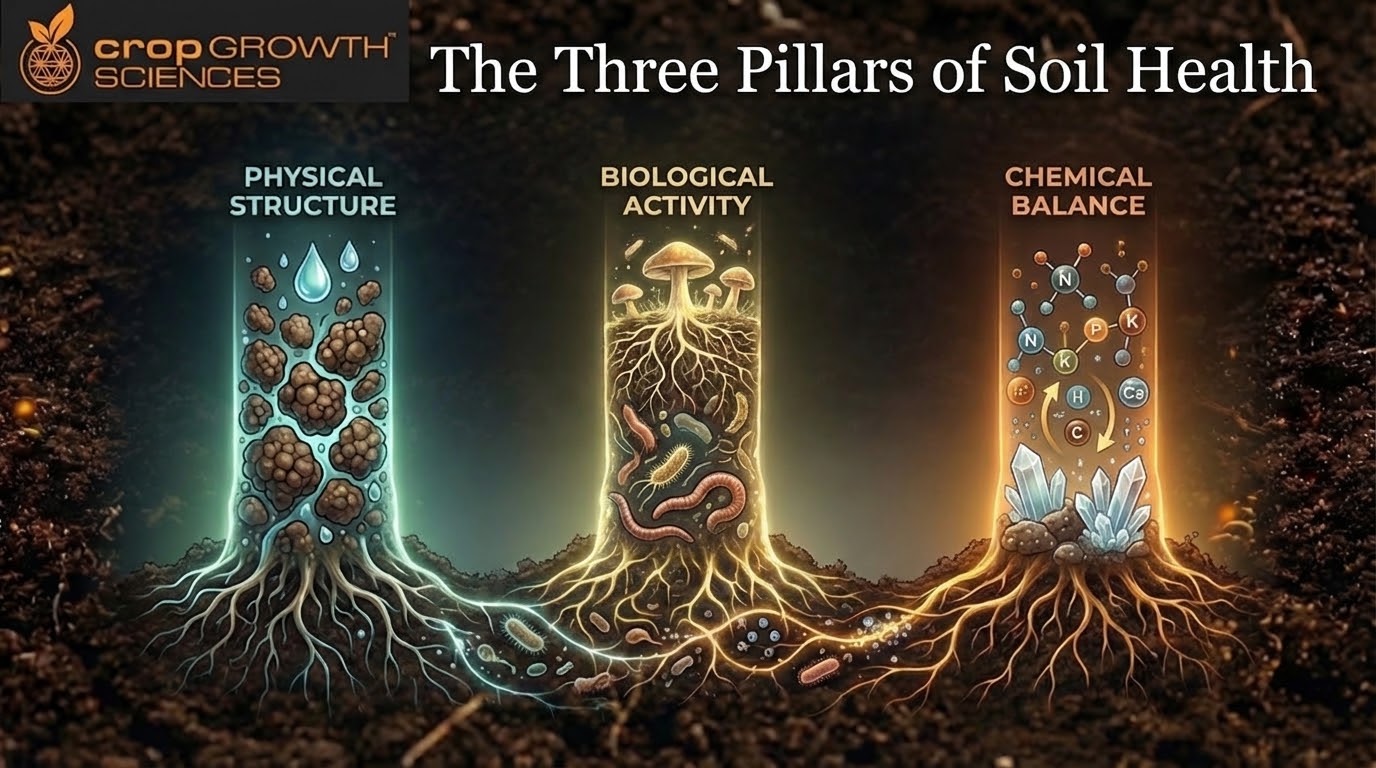
Healthy soil is soil that can function as designed—supporting strong plant growth while cycling air, water, and nutrients efficiently. The Three Pillars work together to make that happen: Open pore networks allow oxygen to move into the root zone and carbon dioxide to move out, supporting vigorous roots and active soil biology. Water is about more than moisture levels—water quality can influence soil structure, and poor-quality water can contribute to surface sealing, compaction, and reduced infiltration. Minerals, especially calcium, help soil particles bind and maintain stable structure and pore space. Carbon and biology power the living system, feeding microbes and creating natural “glues” that build aggregation, resilience, and long-term stability. The caveat is that these minerals must be 'solutionized' in order to participate in the cyclic systems of functioning soils.
Look Familiar? Set up a call to learn more!
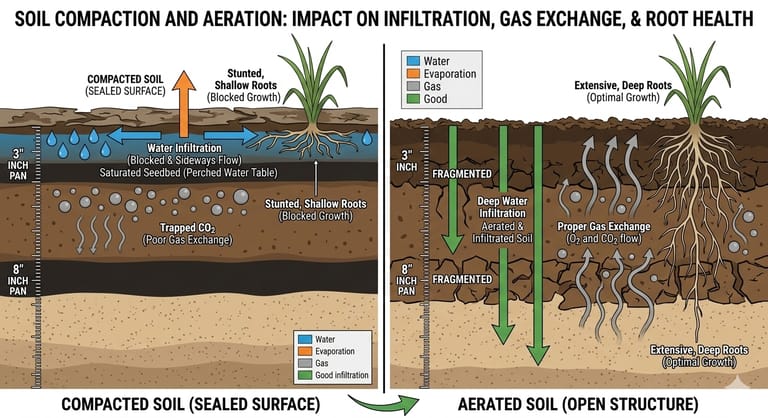
When roots grow sideways and 'J' hook and split or if you can see the lateral root hairs flatten like in this picture, then you are farming in 3 inches of soil or less and compaction under no-till is suffocating your soils. When many farms went no-till, we stopped the plow—but we didn’t remove the legacy plow pan sitting 8–10 inches down, and you can still find it with a shovel today. Over the next 15–20 years, repeated traffic from planters and heavier farm equipment created a new problem closer to the surface: the same soil “weathering” mechanisms that once built a hard layer down deep have effectively moved that compaction zone up into the top 2–3 inches. As soil particles deflocculate, the finest clays and silts detach, migrate downward, and pack into dense layers—closing pores, suffocating biology, and blocking water infiltration and gas exchange. If we don’t actively rebuild aggregation after mechanical relief—using soluble calcium and active carbon to stabilize structure—sealed soils will keep falling apart and re-forming the same restrictive layers, just in a different place.
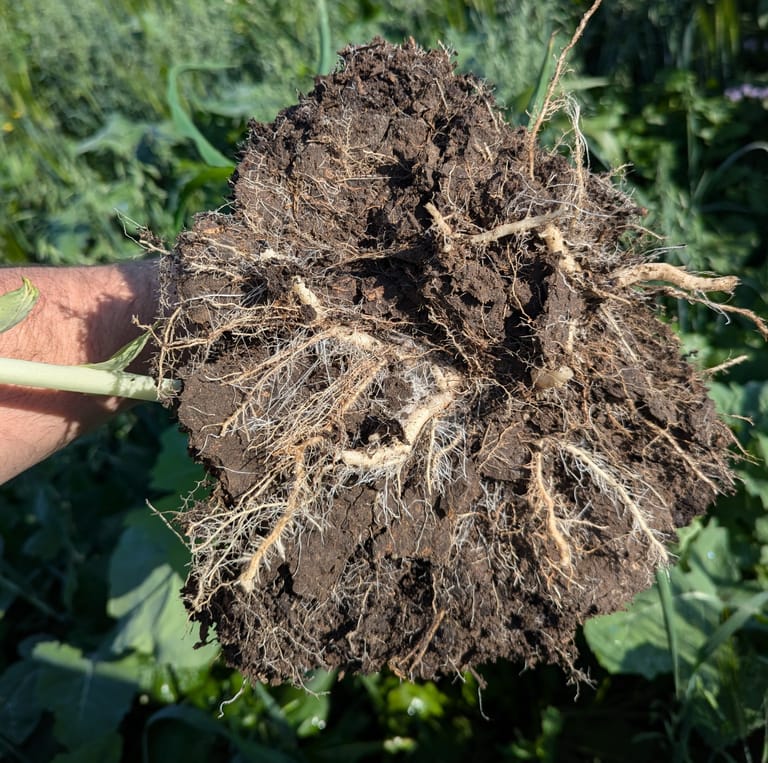
If you have ever pulled up a plant and seen roots that look like this, then you definitely have this yield robbing problem.
Soil health without the hype
Soil health isn’t a trend—it’s the long-standing idea of tilth, updated with modern measurement. “Health” means a soil can function as designed: breathe, infiltrate water, cycle nutrients, and support roots. Our job is to replace product noise with a system that answers three questions:
What is the limiting function in this field?
Which practice or product changes it—measurably?
What rate pays, and where?
If it can’t be measured on your farm, it shouldn’t be scaled across your acres.

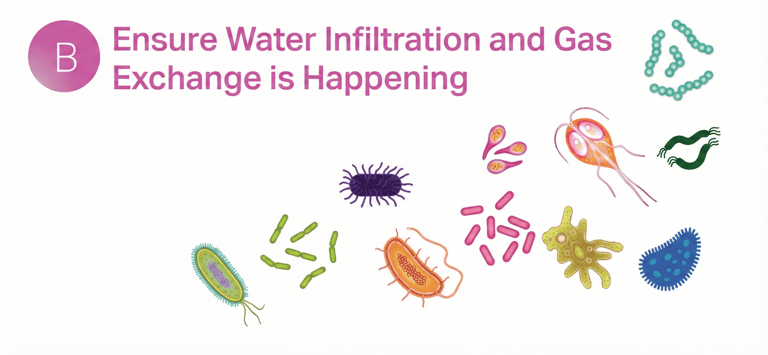
Ask about the simple steps to fixing this problem under long-term no-till practices
Sealed and compacted soils are basically soils that can’t breathe or drink properly—water can’t infiltrate, gases can’t exchange, and roots stay shallow and “stunted.” When the surface seals, you don’t just lose infiltration—you lose biological function too. Oxygen can’t move down into the root zone, carbon dioxide can’t escape, and the soil environment turns hostile for root tips, beneficial microbes, and nitrogen fixation. The end result is a “perched” wet layer after rain, crusting on top, sideways water movement, poor rooting depth, and yield potential capped long before fertility becomes the real limit.
Steel, Calcium, Carbon, and Living Routes
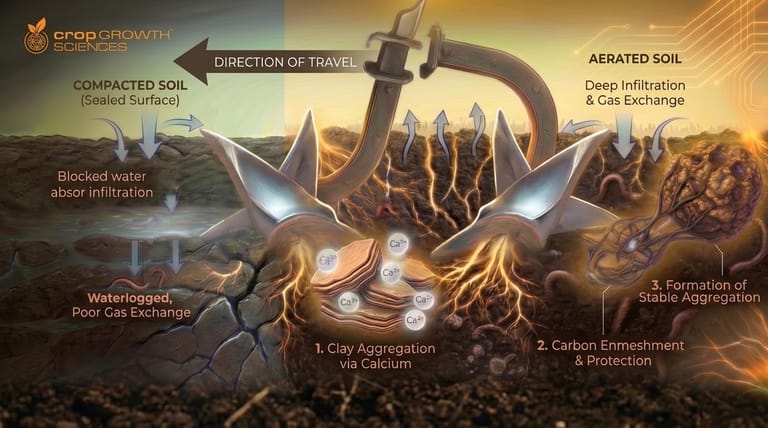
The “Steel, Calcium, Carbon, Living Routes” framework is a practical sequence for reopening the plumbing and rebuilding structure so the soil stops slaking and re-sealing. Steel is the physical route: identify the actual restrictive layer with a spade, then use strategic, minimal disturbance (where needed) to fracture or relieve compaction and create an initial pathway for air and water. Calcium is the electrochemical route: adequate calcium helps clays flocculate (stay “clustered” instead of dispersed), which reduces pore clogging, sealing, and the downward migration of fines that forms dense layers. Carbon is the structural route: carbon sources and residues help bind micro-aggregates into stable crumbs, improving aggregate strength, water stability, and long-term pore space. Living Routes is the biological route: living roots and a diverse microbial community provide the natural “glues” that stabilize structure, build resilient aggregates, and keep channels open—especially when you see worm populations and arthropods rise and begin acting like 24-7 biological tilling machines. Together, these four routes are designed to move sealed, compacted soils from “tight and closed” to “open and functional,” restoring infiltration, gas exchange, and deep, healthy rooting.
© 2026 Crop Growth Sciences CGS Ltd
Tools, Knowledge, Results
Don't be shy!
Give us a call or book an appointment to find out how we can help.
Sometimes it's just quicker talking human-to-human to get to the root of the matter

We always have 5 minutes!
Want more time?
We'd love to hear more about your challenges in greater detail. Easily connect with us on your schedule


We don't show our phone number due to the vast amount of spam bots scraping our number these days. Please click this button on your mobile device. It's toll free!
CGS is an Eco Health Industries and Soil Sense Innovation Collaboration